
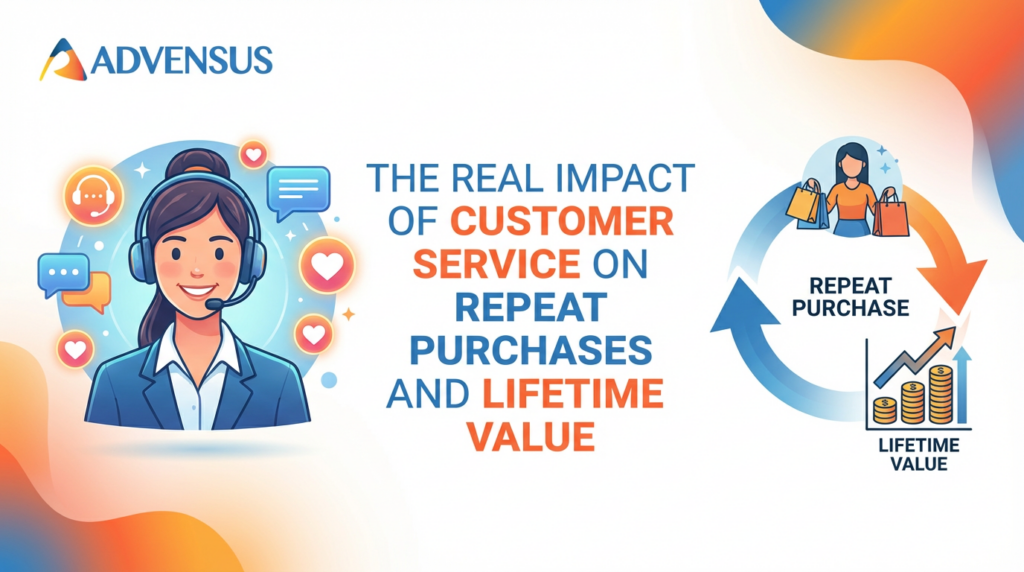
The prevailing view in mid-market and enterprise retail is that customer service is a necessary cost to manage returns and handle complaints. This operational mindset is fundamentally flawed. In reality, a poor Customer Experience (CX) operation is not just an expense; it is a high-velocity source of customer attrition that directly erodes Lifetime Value (LTV) and compresses profit margins.
For Operations VPs and COOs, the imperative is not merely to lower Average Handle Time (AHT) or reduce labor spend. The strategic goal must be to build a resilient, high-quality CX function that transforms service interactions into repeat revenue drivers. When service fails, the immediate cost of the contact is overshadowed by the long-term, unmeasurable cost of a lost customer and the negative impact on brand perception.—–The Operational Failure Points That Destroy Retail LTV
A customer’s decision to repurchase is rarely driven by price alone; it is overwhelmingly influenced by their post-purchase experience. High-growth retail and eCommerce businesses are often undermined by CX infrastructure that cannot flex with demand or deliver consistent resolution.1. Inconsistent Quality Across Channels and Volume Spikes
Retail operations are characterized by severe, predictable peak seasons (Q4, flash sales, major holidays). The standard operational response is to staff for volume, often by using rushed seasonal hires or diverting resources internally.
- The Risk: These temporary solutions introduce massive variability in agent quality and process adherence. A customer who receives excellent service via chat but is subjected to a 15-minute hold time and an untrained agent on the phone perceives the brand as unreliable. Inconsistency breeds distrust.
- The Business Impact: Low QA scores translate directly into higher Customer Effort Score (CES) and lower repurchase rates. A high-value customer whose simple inquiry takes three contacts across two days is a customer you will likely lose to a competitor.
2. The Unacceptable Cost of Agent Empathy Deficit
In retail, agents are the front line of brand recovery. When a shipment is late or a product is flawed, the interaction is emotionally charged. Empathy—defined operationally as the agent’s ability to acknowledge the issue, communicate clearly, and own the resolution—is the most critical driver of customer recovery.
- Operational Insight: Empathetic agents are not just “nicer.” They are better trained in complex problem-solving, have higher discretionary authority, and possess superior soft skills. This requires a significant investment in training and a lower-attrition environment.
- The Trade-off: Reducing training time to shave labor costs directly increases your risk of high-attrition agents who stick strictly to scripts. This robotic, low-empathy service experience may lower AHT marginally, but it guarantees that recovered customers remain “at-risk” customers—or are lost entirely.
Leveraging Nearshore to Architect a Stable, High-LTV CX Model
The pressure to cut operational expenses often leads executives to view traditional outsourcing as a path to the lowest labor rate. This offshore model, however, often introduces cultural and communication friction that is particularly toxic in the high-stakes, service-recovery environment of retail.
Nearshore outsourcing, specifically to regions like the Dominican Republic and Trinidad & Tobago, offers a strategic alternative that balances cost optimization with quality control and cultural alignment. This approach allows VP-level decision-makers to scale their CX capacity without compromising the LTV-driving quality their brand demands.The Nearshore Advantage in Retail Operations
| Operational Metric | Nearshore (DR/T&T) Solution | Business Impact |
| Agent Quality/Attrition | High English proficiency (B2–C2) and strong cultural affinity with the U.S./Canada. Local operations deliver lower overall attrition rates than many domestic or far-shore models. | Higher CSAT/NPS, lower cost-to-train, consistent brand voice, and a stable talent pool that drives complex resolution rates. |
| Scalability & Risk | Flexible engagement models (Staff Augmentation to Full BPO) that allow for rapid, high-quality scaling for peak seasons or new product launches. | Reduced Vendor Risk. Ability to deploy trained, compliant staff (PCI/HIPAA-ready) in weeks, not months, mitigating the risk of service collapse during peak volume. |
| Communication & Time Zone | Time-zone alignment with EST/CST. Cultural understanding of U.S. consumer expectations. | Reduced Friction. Real-time management and coaching. Agents operate on the same workday as the U.S. customer and corporate headquarters, eliminating the most common pain points of far-shore operations. |
Example Scenario: Mitigating High-Volume Failure
A mid-market eCommerce brand experiences 300% volume spike following a successful Black Friday campaign.
- The In-House/Offshore Risk: In-house teams are quickly overwhelmed, causing AHT and Queue Times to spike. An existing offshore partner struggles to staff up quickly, and the new, rushed agents have low language proficiency, leading to repeated calls and compounding the problem. The result is a flood of one-star reviews and abandoned carts.
- The Nearshore Solution: A nearshore partner, operating on a flexible BPO model, activates a pre-vetted, trained cohort of agents with a strong grasp of U.S. retail processes. Time zone alignment allows the partner to immediately support the highest-demand windows. Resolution rates remain stable, and CSAT dip is minimized, protecting the LTV of the newly acquired customers.
Final Thought
Customer service is not a transactional expense; it is a long-term capital investment. When operations leaders frame the CX function around LTV and utilize the strategic advantages of a high-quality nearshore partnership, they convert a historical cost center into a repeatable driver of repurchase and revenue compounding.
Evaluate whether your current CX operation is structurally supporting long-term customer value, or merely managing transactions. Assess your exposure to operational risk during peak volume and the quantifiable cost of agent inconsistency on your brand’s retention metrics.