
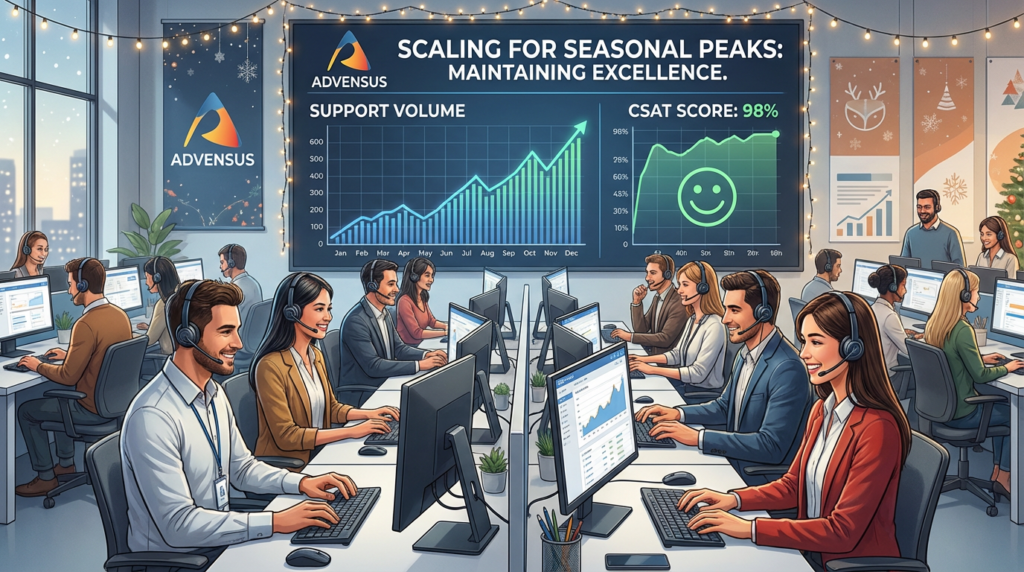
Seasonality is one of the biggest operational challenges in retail and eCommerce. Black Friday, holiday sales, product launches, and promotional campaigns can drive interaction volumes up by 2x or even 5x in a matter of weeks. For operations leaders, the challenge isn’t demand — it’s scaling customer support fast enough without degrading the customer experience. The consequence of failure is direct: service level drops lead to abandoned carts, public brand damage on social channels, and a significant, measurable drag on repeat purchase rates that persists long after the holiday season concludes.
Many retail brands attempt to solve this by overstaffing year-round—a costly CapEx drain—or pushing internal teams beyond sustainable capacity during peak periods. Both approaches are fiscally irresponsible and operationally fragile. The most resilient retail organizations plan for seasonality as a permanent operating condition, not a temporary problem, by building a flexible support foundation.Why Traditional Scaling Models Fail in Retail Operations
Scaling failures in customer operations are rarely due to a lack of intent; they are structural. When peak volume hits, the following issues consistently erode service quality and balloon costs:The Internal Capacity Trap
Relying solely on internal hires for peak season exposes the operation to high fixed costs and high risk.
- Long Hiring and Onboarding Timelines: The timeline to source, hire, and train a large seasonal cohort often consumes the window needed to achieve preparedness, leading to unprepared agents taking live contacts.
- Inconsistent Training Quality: Rapid, high-volume onboarding compromises training consistency. New agents lack the deep product knowledge and soft skills necessary for high-value interactions, directly driving down First Contact Resolution (FCR) and increasing Average Handle Time (AHT).
- Poor Forecasting: Many operations forecast based strictly on sales projections, not on the nuanced contact volume drivers (e.g., returns, “where is my order,” product assembly questions). This misalignment guarantees resource scarcity at the moment of highest customer pressure.
When service levels drop during peak seasons, CSAT, NPS, and repeat purchase rates suffer—often long after the season ends. This creates a multi-quarter revenue tail risk that few VPs can afford.The Strategic Case for Flexible Nearshore Support
The core of a scalable retail operation is a variable cost structure that can flex with demand. Nearshore customer support allows retail brands to add significant, high-quality capacity quickly without incurring long-term headcount risk or the operational friction of purely offshore models.
Nearshore partners, specifically those in the Caribbean and Latin America, provide critical structural advantages for U.S. and Canadian retailers:Operational Resilience Through Time Zone and Culture
- Time Zone Alignment: Operating within the same time zones (EST, CST) as the primary U.S. consumer base reduces scheduling complexity, simplifies real-time management, and ensures coverage exactly when peak demand hits—during business hours and early evenings.
- Strong English Proficiency and Cultural Familiarity: The high English proficiency (B2–C2) and cultural affinity (understanding of U.S. retail events, product trends, and consumer behavior) significantly reduce agent ramp-up time compared to models where cultural nuance is a significant training lift. This allows agents to maintain consistent QA and brand voice from day one.
Risk-Adjusted Capacity Management
A true flexible nearshore partner offers a variable staffing model designed to neutralize the seasonal headcount risk:
- Rapid Deployment: Teams can be fully ramped in weeks, not the months required for internal hiring cycles. This responsiveness is critical for handling unexpected volume spikes, such as a viral product launch or a supply chain failure.
- Scale Up and Down without Cost Penalty: The ability to add and retract agents based on a rolling forecast eliminates the costly overhead of permanent excess capacity, turning a fixed cost into a variable one. This is a critical factor for CFOs focused on operating leverage.
KPIs to Protect During Peak Demand and How Nearshore Helps
Scaling is only successful if the core experience metrics remain stable or improve. Sacrificing quality for speed is a false economy. Operations leaders must anchor the seasonal strategy to these KPIs:
| KPI | Operational Risk During Peak | Nearshore Mitigation Strategy |
| CSAT and NPS | Degrades sharply due to long hold times and unprepared agents. | High-proficiency agents with cultural fit deliver empathetic service, protecting the brand experience at scale. |
| Average Handle Time (AHT) | Spikes as new agents fumble, increasing labor costs unnecessarily. | Structured training programs and experienced BPO management ensure consistent adherence to AHT targets from the first contact. |
| First Contact Resolution (FCR) | Drops as agents are unable to resolve complex product and order issues on the first call, driving up repeat contact volume. | Dedicated training on retail-specific platforms (e.g., Shopify, Salesforce Commerce Cloud, Zendesk) and comprehensive quality assurance maintain high FCR, reducing overall contact volume. |
| Schedule Adherence | Internal burnout and poor scheduling practices lead to unexpected gaps in coverage. | Professional BPO workforce management (WFM) ensures optimal agent coverage to meet service level agreements (SLAs), protecting against the operational risk of understaffing. |
Final Thought
Seasonal demand is not an emergency; it is the operating reality of modern retail. The most successful VPs of Operations and Customer Experience treat scalability as a strategic capability, not a tactical fix. By integrating a flexible, high-quality nearshore solution, retail leaders can shift from a reactive, high-cost seasonal scramble to a proactive, risk-mitigated strategy that protects both revenue and customer loyalty. The decision is simple: continue absorbing the cost and risk of the internal capacity trap, or build a truly resilient, variable cost support structure.
Soft CTA: Evaluate whether your current support model is built to scale effectively or if your retail operation is exposed to unnecessary seasonal risk.