
Getting care should not feel like a second job.
For many patients, the hardest part of healthcare is not always the appointment itself. It is everything that happens before it: finding the right provider, scheduling a visit, confirming insurance, understanding costs, completing intake forms, getting prior authorization, and knowing who to call when something changes.
That front-end experience is now one of the biggest pressure points in healthcare.
Experian Health’s 2026 State of Patient Access report shows a clear gap between how providers see progress and how patients experience it. While 46% of providers say patient access has improved, most patients report little change. Timely appointments remain the top concern for the fourth year in a row, and nearly one-third of patients say paying for care has become worse than the year before.
That matters because patient access is not just an administrative function. It affects revenue, retention, care quality, staff workload, and the patient’s first impression of the organization.
The first point of contact shapes the entire experience
A patient may judge a healthcare organization before they ever meet a clinician.
Was the phone answered?
Was the scheduling process clear?
Did the agent understand the patient’s need?
Was insurance verified correctly?
Did the patient know what to bring, what to expect, and what it may cost?
When the answer is no, the result is usually more friction. Patients miss appointments. Calls increase. Staff repeat work. Claims may be delayed. Providers lose capacity. Patients lose confidence.
In 2026, healthcare organizations cannot afford to treat the front desk, call center, intake team, and billing support as separate pieces. Patients experience them as one journey.
Cost clarity is now part of patient access
Healthcare costs are harder for patients to ignore. More people are asking about coverage, deductibles, payment responsibility, and estimates before receiving care. If those answers are unclear, the patient may delay the appointment or look elsewhere.
This is where the front-end team becomes critical. A well-trained support model can help patients understand next steps without turning every financial question into a confusing handoff.
That does not mean every agent needs to solve every billing issue. It means the process should be designed so patients are not passed from person to person without context.
Automation helps, but it cannot carry the full experience
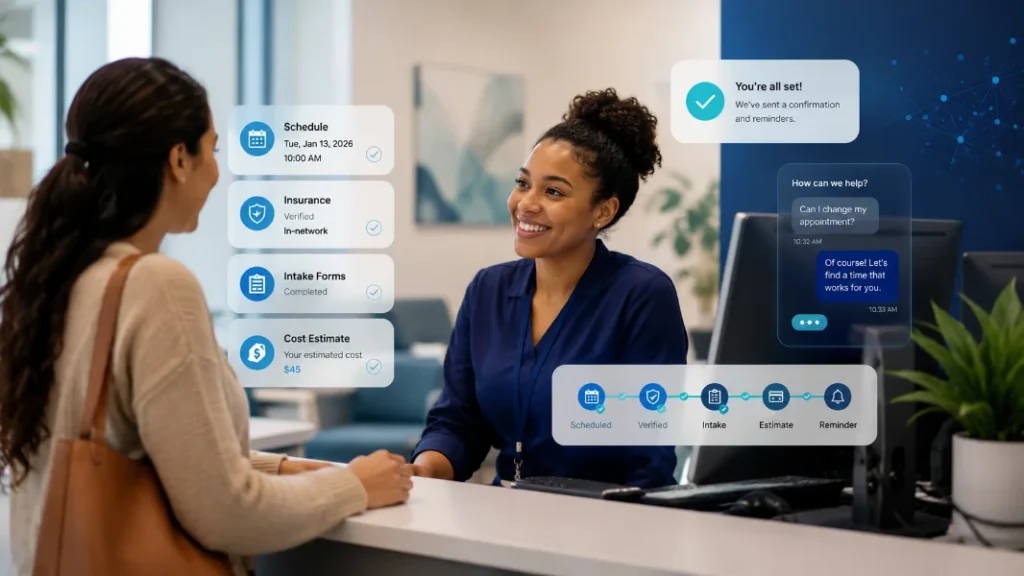
Digital tools can reduce friction. Online scheduling, automated reminders, eligibility checks, intake forms, chat support, and AI-assisted workflows can all help.
But automation alone does not solve patient access.
Patients still need human support when the situation is complex, emotional, or unclear. A patient trying to schedule care after a diagnosis, resolve an insurance issue, or understand a denied authorization may not want another portal link. They may need a person who can explain the process calmly and move the case forward.
Deloitte’s 2026 healthcare outlook points to digital health, AI, and care delivery transformation as major priorities for healthcare organizations, but the same report notes that traditional care models are still under pressure. More than 41% of surveyed executives said care delivery transformation will affect their strategy in 2026.
The practical lesson is simple: technology should support the front-end experience, not replace the responsibility to guide patients.
Patient access and revenue cycle are becoming connected
The line between patient access and revenue cycle is getting thinner.
Eligibility errors, incomplete intake, missed authorizations, unclear estimates, and poor follow-up can create problems later in the revenue cycle. A weak front-end process often becomes a back-end financial issue.
Healthcare revenue cycle trends for 2026 point to the same pressure: organizations are trying to modernize operations, address staffing shortages, improve cybersecurity, and improve patient experience at the same time.
That means patient access teams need better training, better workflows, and better coordination with billing, clinical operations, and payer-related teams.
A smarter model should help with:
- Scheduling and rescheduling.
- Insurance verification.
- Prior authorization support.
- Referral coordination.
- Intake completion.
- Appointment reminders.
- Patient follow-up.
- Payment and estimate questions.
- Clear escalation for complex cases.
This is not only about reducing hold times. It is about reducing confusion.
The smarter front-end model for 2026
Healthcare organizations need a front-end support model built around three things: access, accuracy, and empathy.
Access means patients can reach someone through the right channel and get a useful answer.
Accuracy means information is captured correctly from the start, reducing rework, claim issues, and delays.
Empathy means patients are treated like people navigating a stressful system, not like tickets in a queue.
The strongest healthcare organizations in 2026 will not view patient access as a basic administrative layer. They will view it as a strategic part of care delivery.
For healthcare organizations looking to strengthen that front-end operation, Advensus supports patient communication, appointment scheduling, back-office healthcare support, quality assurance, and scalable nearshore teams. The goal is to help healthcare providers improve access, reduce operational friction, and give patients a clearer path from first contact to care.