
Protecting Peak Revenue: The Operational Strategy for Scaling Retail CX Teams in Weeks, Not Months → The Operational Pressure of Retail Volatility → The True Cost of Internal Peak Scaling
Protecting Peak Revenue: The challenge for VPs of Operations in the retail and eCommerce sector is a near-universal and annual event: how to absorb a 200%, 300%, or even greater surge in customer contacts during peak season without hemorrhaging revenue or damaging brand reputation. The traditional internal strategy—hiring, training, and housing hundreds of temporary agents—is expensive, inefficient, and fraught with compliance and quality risks. The reality is that the operational risk of understaffing during peak demand directly translates to lost sales, higher cart abandonment rates, and a spike in post-holiday returns that strains the system well into Q1. The strategic decision is not if you need to scale, but how to do it reliably, quickly, and with zero long-term headcount liability.
The Operational Pressure of Retail Volatility: Retail operations are defined by extreme, non-linear volatility. Unlike subscription or utility models, the demand curve is unpredictable, sharp, and unforgiving. The cost of a bad customer experience (CX) during Q4 is exceptionally high: a resolution delay costs not just an individual sale, but the lifetime value of a customer who defected to a competitor with better support.
The True Cost of Internal Peak Scaling: Relying solely on internal resources for extreme scaling creates several untenable costs and risks:
| Operational Risk Factor | Internal Approach Cost/Risk | Nearshore Partnership Mitigation |
| Speed to Market | 12-16 weeks for full recruitment, hiring, and onboarding. High failure rate. | Weeks-to-live deployment via pre-vetted, trained pools. |
| Headcount Liability | Mandatory severance, unemployment claims, and administrative overhead for mass Q1 layoffs. | Zero long-term risk. Flexible contract terms for scale-down. |
| Quality & QA | Rushing training leads to high errors, low first-call resolution (FCR), and CSAT decline. | Outsourcing provider maintains dedicated QA and training infrastructure at scale. |
| Capital Expenditure | Leasing temporary space, buying and installing hundreds of workstations and telephony licenses. | Capex is absorbed by the BPO partner. Operational expense model. |
The key operational metric during this period is Protected Revenue per Agent. If an agent saves a $500 cart or successfully upsells a warranty, they are directly protecting revenue. A poorly trained, overwhelmed internal seasonal agent is a drag on this metric.Strategy 1: Decoupling Transactional vs. Complex Support
Effective scaling begins by segmenting your demand profile. Not all customer contacts carry the same risk or require the same agent skill level.H2: The Tiered Approach to Peak Season Volume
A common mistake is treating all contact types equally. A strategic approach identifies the high-volume, repeatable tasks that can be rapidly outsourced, freeing up your core, in-house team for high-value or complex escalations.
Tier 1: Volume & Speed (Ideal for Nearshore BPO)
- Contact Types: Order status lookups, simple return authorizations, basic password resets, product availability checks, tracking inquiries.
- KPI Focus: Average Handle Time (AHT), First Call Resolution (FCR), and Service Level (SL).
- Business Impact: Reduces wait times dramatically, protects brand during the busiest periods.
Tier 2: Escalations & Value (Retained In-House or Specialized BPO Team)
- Contact Types: Fraud identification, complex B2B orders, product technical support, VIP/loyalty customer service, high-value retention efforts.
- KPI Focus: Net Promoter Score (NPS), Customer Satisfaction (CSAT), and Revenue Per Contact Hour.
- Business Impact: Protects brand equity and maximizes the revenue from high-value interactions.
By deploying a nearshore partner to manage Tier 1 volume, the VP of CX is effectively creating a buffer against systemic breakdown. The partner absorbs the surge, maintaining a stable SL, while the in-house team remains focused on quality, high-touch support.Strategy 2: Leveraging Nearshore Scalability for Retail
Retail needs speed and cultural alignment. This is where a nearshore strategy, particularly in locations like the Dominican Republic and Trinidad & Tobago, offers a distinct operational advantage over traditional offshore models.H3: Why Nearshore Outpaces Offshore for Retail Speed
The primary operational buying triggers for a retail executive are Speed and Quality of Interaction.
- Time Zone Alignment (EST/CST): Seamless real-time management and agent scheduling. A contact center in the Dominican Republic operates on the same clock as the U.S. East Coast shopper, eliminating overnight supervision or service lag associated with the Philippines or India.
- Cultural Affinity: Retail customers expect a natural, effortless conversation. High English proficiency (B2–C2) combined with strong cultural familiarity with U.S. holidays, media, and shopping habits reduces the friction and frustration that often plagues offshore support, directly improving CSAT.
- Speed of Deployment: Established nearshore providers maintain a constant bench of high-quality, pre-screened talent. When a VP needs 200 agents in a matter of weeks, the infrastructure and talent pool are already mobilized, reducing the time-to-live from months to a few weeks.
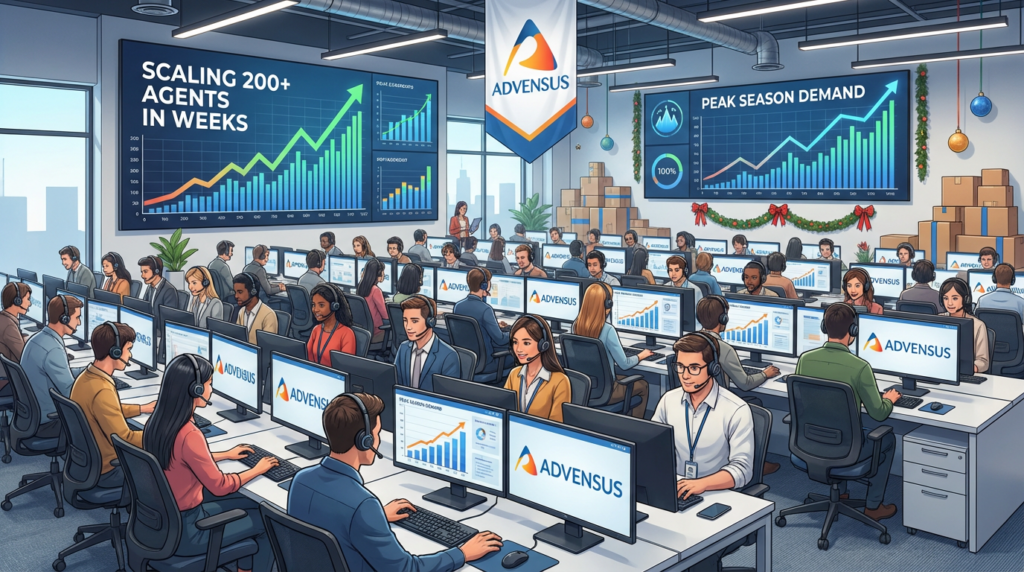
Example Scenario: Scaling 200+ Agents in Weeks for Peak Season Demand
When a national retailer faced a holiday surge, speed mattered more than perfection. By leveraging a nearshore team, they scaled hundreds of agents in weeks while maintaining QA and CSAT. The result: protected revenue, stable CX, and zero long-term headcount risk. This rapid deployment capability is not a marketing feature; it is a critical business continuity mechanism for an industry defined by demand spikes.Operational Decision Factors: Selecting a Flexible Partner
A flexible engagement model is paramount. Retail demand is not fixed; it rises, falls, and shifts based on marketing campaigns, inventory levels, and macroeconomic factors. The vendor must be willing to match this volatility.H2: The Strategic Value of Flexible Engagement
Your partnership model should offer genuine flexibility, not a locked-in, rigid structure. Look beyond the standard full Business Process Outsourcing (BPO) model to options like:
- Staff Augmentation: Using the partner’s agents and infrastructure while you retain full operational oversight and training control. Ideal for quick, high-volume capacity relief.
- Hosted Services: Leveraging the partner’s technology (ACD, CRM, WFM) and physical space while deploying your own management team. A middle ground for maintaining control with lower Capex.
The strategic conversation with a potential partner must focus on their commitment to a rapid, low-friction scale-down in Q1. A quality partner ensures the risk of over-capacity disappears once the seasonal pressure is relieved.—–Business Impact: Shifting from Cost Center to Revenue Protector
For the COO or CFO, the decision to outsource peak season support is evaluated on risk mitigation and financial impact. The question isn’t “How much do we save?” but “How much revenue do we protect?”
| Metric | Pre-Outsourcing Risk | Post-Nearshore Strategy Impact |
| Service Level (SL) | Drops to <50% during peak hours, leading to abandonment and lost sales. | Maintained at 80% or better due to surge capacity. |
| Abandoned Cart Rate | Rises as customers can’t get pre-purchase questions answered. | Stabilizes as immediate chat/voice support is available. |
| Agent Attrition | Seasonal agent turnover spikes post-holiday (high replacement cost). | BPO manages attrition risk, guaranteeing consistent staffing levels. |
| CX Risk | Negative social media and brand damage from poor holiday service. | Brand protected by culturally aligned, high-quality interactions. |
By operationalizing an elastic, nearshore support capacity, a retail organization secures its ability to capture peak demand revenue while mitigating the catastrophic operational risk of a system failure. The nearshore model provides the necessary blend of quality interaction and rapid, temporary scalability that U.S. and Canadian retailers require.
Assess whether your current support model is built to scale or built to break under pressure. Prepare now—peak season scaling shouldn’t be improvised.